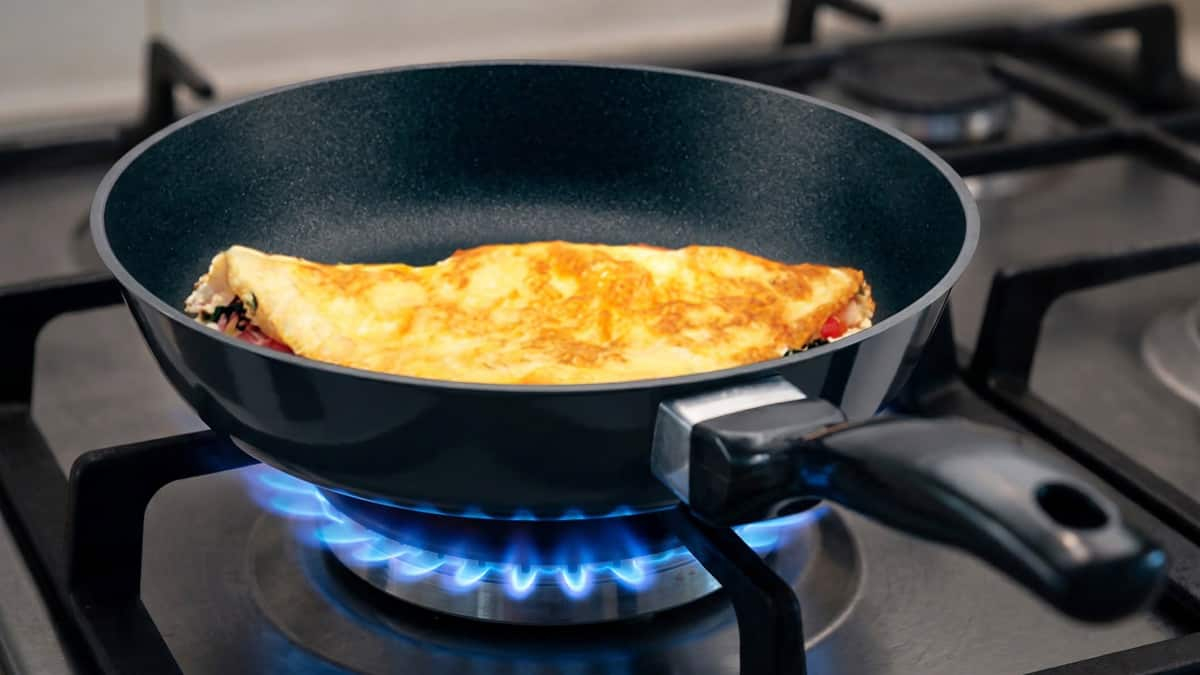
I recently bought a new hard-anodized aluminum nonstick pan, and something unexpected happened during its first use.
After placing it on the stovetop and letting it heat, I noticed a faint chemical-like smell.
There was no visible smoke. The burner was not set unusually high, and the cooking surface looked completely normal.
Still, the odor was noticeable enough to make me wonder:
Is it normal for a brand-new nonstick pan to smell when heated?
Rather than assume the cookware was defective—or assume the smell was harmless—I decided to investigate and keep track of what happens during the first several uses.
KEY OBSERVATIONS AT A GLANCE
- Cold surface: No noticeable chemical odor.
- Heated surface: A faint chemical-like odor appears.
- Visible surface condition: No peeling, bubbling, cracking, or other obvious damage.
- What I am doing next: Observing the pan during normal cooking and cleaning cycles instead of repeatedly heating it empty.
What Happened With My New Nonstick Pan
The pan was brand new.
Before using it, I washed it thoroughly with water and mild dish soap.
After washing, I checked the pan while it was cold.
There was no unusual smell.
Then I placed it on the stovetop.
Once the cooking surface became hot, I could detect the faint chemical-like odor again.
That was the part that caught my attention.
If the pan had simply smelled like chemicals straight out of the package, packaging material or something left on the surface would have been an obvious possibility.
But in my case, the odor became noticeable primarily after the cookware was heated.
I also inspected the cooking surface closely.
I could not see any obvious:
- peeling
- bubbling
- blistering
- cracking
- flaking
- coating damage
The nonstick surface looked normal.
So instead of repeatedly heating the empty pan to reproduce the smell, I decided to use it normally, wash it between uses, and see whether the odor gradually decreases.
Hard-Anodized Aluminum and Nonstick Coating Are Not the Same Thing
This is an important distinction.
Hard-anodized aluminum and a nonstick coating are not the same surface treatment.
Hard anodizing creates a harder aluminum-oxide layer on the aluminum surface.
A hard-anodized aluminum nonstick pan, however, may also have a separate nonstick coating over the anodized base.
So if a coated hard-anodized pan produces an odor when heated, it would be inaccurate to immediately conclude:
“The anodized aluminum itself is giving off a chemical smell.”
The cookware may contain several materials, and without laboratory testing it is difficult to identify exactly where a faint odor originates.
Possible explanations could include trace manufacturing residue, oils, adhesive residue, material elsewhere on the cookware, or something associated with the nonstick coating system.
That is why I would be cautious about describing every first-use odor as either completely “normal” or automatically “dangerous.”
Smell alone does not tell us enough to make that conclusion.
Can a New Nonstick Pan Have an Odor?
Reports of new nonstick cookware producing an unusual odor during early use are not difficult to find.
Some owners describe it as chemical-like, plastic-like, or simply a “new pan” smell. In some reports, the odor becomes weaker or disappears after repeated washing and normal cooking.
Those experiences are useful because they show that my observation is not unique.
But consumer experiences cannot tell us which material caused the smell, and they do not prove that every new nonstick pan should produce an odor.
That difference matters.
I would not assume that a strong or persistent chemical odor is harmless simply because the cookware is new.
What the FDA Says About Nonstick Cookware Coatings
There is also plenty of confusion online about nonstick coatings and PFAS.
According to the U.S. Food and Drug Administration, certain PFAS are authorized for use in some nonstick cookware coatings. The FDA says these coatings are highly polymerized and tightly bound to the cookware, with studies showing negligible amounts capable of migrating into food from these authorized coatings. (U.S. Food and Drug Administration)
That is useful context because noticing an odor does not automatically mean chemicals are migrating into food.
At the same time, intended use and severe overheating are very different situations.
Why Medium Heat Does Not Guarantee a Moderate Pan Temperature
This was one of the most important things I considered during my test.
The setting on a stovetop burner does not tell you the exact temperature of the cooking surface.
An aluminum pan can heat quickly, especially when it is empty.
The final surface temperature depends on the power and size of the burner, how long the pan has been heating, the thickness and design of the cookware, and whether food is absorbing some of the heat.
So:
Medium burner setting does not automatically mean a moderate pan temperature.
An empty pan can continue getting hotter even though the burner knob has not moved.
This is one reason extended dry preheating is not a good way to investigate a smell from nonstick cookware.
Why I Would Not Heat It Empty to “Burn Off” the Smell
If a new nonstick pan smells slightly when heated, it may be tempting to leave it empty on the burner until the odor disappears.
I would not do that.
Poison Control warns that PTFE-coated cookware can release fumes if it becomes severely overheated, and an empty pan can reach high temperatures faster than many people expect. (Poison Control)
That does not mean my particular pan uses a PTFE coating, and it does not prove that the faint odor I noticed came from an overheated coating.
Nonstick coating chemistry can differ between cookware products.
The practical lesson is much simpler:
Do not deliberately overheat nonstick cookware in an attempt to get rid of a new-product smell.
Normal cooking is a more useful real-world test.
BEST PRACTICES FOR FIRST-TIME USE
- Wash the pan thoroughly with warm water and mild dish soap before first use.
- Avoid extended empty preheating or unnecessarily high heat.
- Follow the cookware manufacturer’s specific heating and care instructions.
- Observe whether the odor changes over several normal cooking and cleaning cycles.
- Check the stovetop and burner area as well, since residue there can also produce an odor when heated.
Will the Smell Fade After a Few Uses?
This is the part of my experiment that is still ongoing.
I washed the pan thoroughly before using it.
Cold surface: no noticeable chemical odor.
Heated surface: faint odor noticeable.
Visible coating damage: none.
Now I am going to continue using the pan normally rather than repeatedly heating it empty.
What I am watching for is a pattern.
For example:
Use 1: noticeable
Use 2: weaker
Use 3: barely noticeable
Use 4 or 5: gone
If that happens, it would make a temporary first-use issue more plausible, possibly involving trace residue or material associated with the pan being new.
But I do not want to claim that before actually observing it.
If the odor remains equally noticeable after several normal cooking and cleaning cycles—or becomes stronger—that would change my conclusion.
Should You Season a New Hard-Anodized Nonstick Pan?
I would not automatically treat a coated nonstick pan like cast iron.
Traditional cast-iron seasoning involves heating oil so that it forms a polymerized layer on the metal.
A coated nonstick cooking surface already has an engineered surface designed to reduce sticking.
Using a small amount of oil during normal cooking is one thing.
Deliberately heating a coated pan to very high temperatures to “season” it is another.
If the manufacturer provides specific first-use or seasoning instructions, those should take priority.
For a new coated pan, washing it properly and then using it according to the manufacturer’s directions is a more sensible starting point than trying to perform a high-heat burn-in.
When a New Nonstick Pan Smell Would Concern Me
A faint odor during an early use that becomes progressively weaker is one situation.
A smell that persists, becomes stronger, or appears alongside visible damage is something else.
I would stop using a new nonstick pan and contact the manufacturer or retailer if I noticed:
- strong chemical fumes during ordinary cooking
- visible smoke at expected cooking temperatures
- coating that begins bubbling or blistering
- peeling or flaking
- unusual surface damage or discoloration
- an odor that remains strong after several normal washing and cooking cycles
- eye, throat, or breathing irritation when the cookware is heated
I would also check the stovetop before assuming the pan is responsible.
Grease, cleaning products, food residue, or other material around a burner can sometimes create an odor only after the area becomes hot.
Using another clean piece of cookware on the same burner can help determine whether the smell may be coming from the stovetop rather than the pan.
REASSURING SIGNS
- ✓ Faint initial odor that becomes weaker with normal use and washing.
- ✓ Clean, intact cooking surface with no bubbling, peeling, or cracking.
- ✓ No smoke or eye, throat, or breathing irritation during normal cooking.
WARNING SIGNS
- ✕ Persistent or worsening chemical odor after several uses.
- ✕ Visible smoke, bubbling, peeling, flaking, or unusual surface damage.
- ✕ Odor accompanied by eye, throat, or respiratory irritation.
What I Think So Far
Based on the first use alone, I am not ready to call my new hard-anodized aluminum nonstick pan defective.
It has no noticeable odor while cold.
The smell becomes faintly noticeable only after the cookware heats up.
The cooking surface looks normal, with no peeling, bubbling, or visible damage.
And similar temporary odors have been reported by other people using new nonstick cookware.
But I am also not going to say:
“It’s new, so the chemical smell is definitely normal.”
That would be guessing.
The more useful test is what happens after several normal cooking cycles.
So I am continuing to use the pan normally, cleaning it with mild dish soap between uses, avoiding unnecessary empty preheating, and paying attention to whether the odor becomes weaker.
FAQs
Is a faint chemical smell normal for a new nonstick pan?
Some people report a temporary odor during the first few uses of new nonstick cookware, but smell alone cannot identify the cause. A faint odor that quickly fades is different from a strong or persistent chemical smell, which should be investigated rather than ignored.
Should I heat an empty nonstick pan to burn off the new smell?
No. Intentionally heating an empty nonstick pan for a long period can cause the surface temperature to rise quickly. Wash the cookware first, follow the manufacturer’s instructions, and use it normally rather than trying to burn off an odor.
Does a hard-anodized nonstick pan need seasoning?
Do not automatically season coated hard-anodized cookware like cast iron. Follow the manufacturer’s instructions for the specific pan. Normal cooking with a small amount of oil is different from deliberately performing a high-heat seasoning process.
When should I stop using a new nonstick pan?
Stop using it and contact the manufacturer or retailer if the odor remains strong or worsens, the coating bubbles, peels or flakes, visible smoke appears during normal use, or heating the pan causes eye, throat, or breathing irritation.
Update Coming After Several Uses
This started with a very simple question:
Why does my brand-new nonstick pan smell when it gets hot?
After the first use, I still do not have a definitive chemical explanation—and I do not want to invent one.
The next few uses should tell me something much more practical:
Does the odor gradually disappear as the new pan is washed and used, or does it persist?
I’ll update this article once I have that answer.