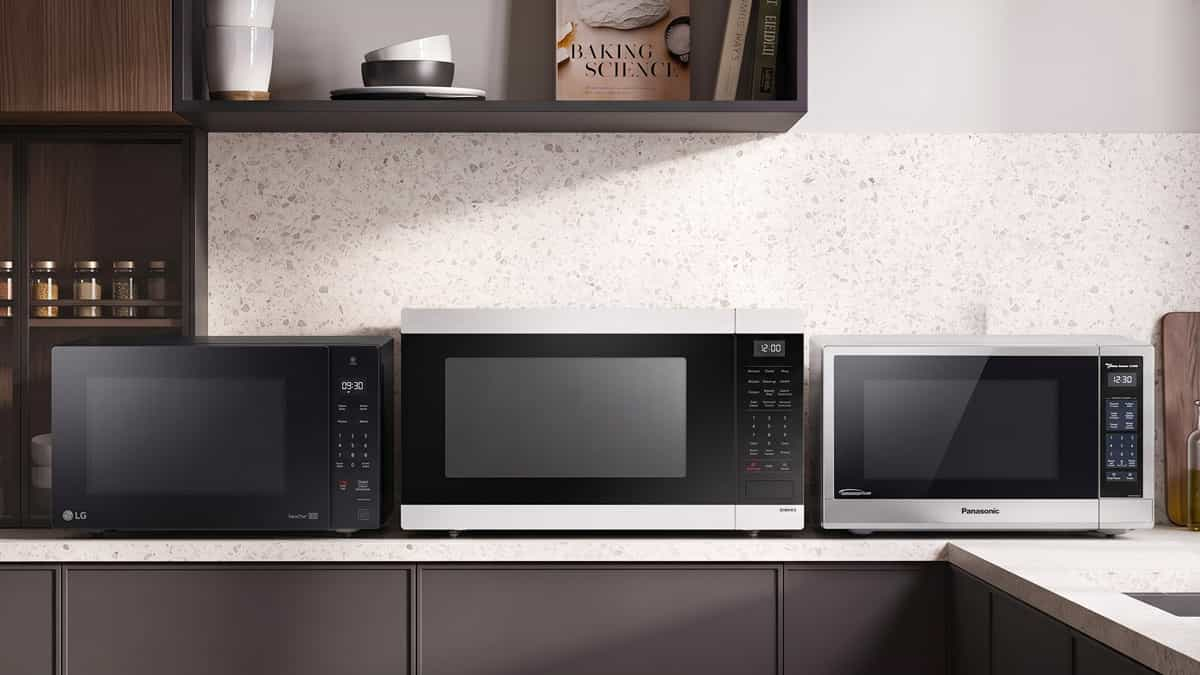
Shopping for a large countertop microwave can get confusing quickly. Samsung, Panasonic, and LG all sell spacious models with sensor cooking, but the technology inside them is not the same.
For this comparison, I looked at three large countertop microwaves currently represented in the U.S. market:
Samsung MS19DG8500SRAA — 1.9 cu. ft.
Panasonic NN-SN97JS — 2.2 cu. ft.
LG MSER2090S — 2.0 cu. ft.
These are not identical in capacity, but they occupy a similar large-countertop-microwave category and make an interesting comparison for shoppers who want plenty of interior space.
One important detail stood out during the research: microwave power consumption and cooking output are not the same number. That distinction matters especially with the Samsung model.
Samsung vs Panasonic vs LG Microwave Specs
| Feature | Samsung MS19DG8500SRAA | Panasonic NN-SN97JS | LG MSER2090S |
|---|---|---|---|
| Capacity | 1.9 cu. ft. | 2.2 cu. ft. | 2.0 cu. ft. |
| Microwave cooking output | 950W | 1250W | 1200W |
| Power technology | 10 power levels | Cyclonic Wave Inverter | Smart Inverter |
| Sensor cooking | Yes | Genius Sensor | Yes |
| Power levels | 10 | 11 | 10 |
| Turntable | Yes | 16.5 in. | 16 in. |
| Interior | Ceramic enamel | Easy-clean interior | EasyClean® |
| Optional trim kit | 30 in. | 27 or 30 in. | 30 in. |
| Dimensions W × H × D | 23 5/8 × 13 5/16 × 18 7/16 in. | 23 7/8 × 14 × 19 7/16 in. | 23 7/8 × 13 9/16 × 19 3/8 in. |
Samsung’s current U.S. specification sheet lists a 950W microwave output, 1600W power consumption, 10 cooking power levels, Sensor Cook and a ceramic-enamel interior.
Panasonic lists the NN-SN97JS at 2.2 cu. ft. and 1250W, with Cyclonic Wave Inverter technology, an 16.5-inch turntable, 11 power levels and 20 Auto Cook programs.
LG’s MSER2090S provides 2.0 cu. ft., 1200W output, Smart Inverter, 10 power levels, seven Sensor Cook options and a 16-inch turntable.
Samsung MS19DG8500SRAA
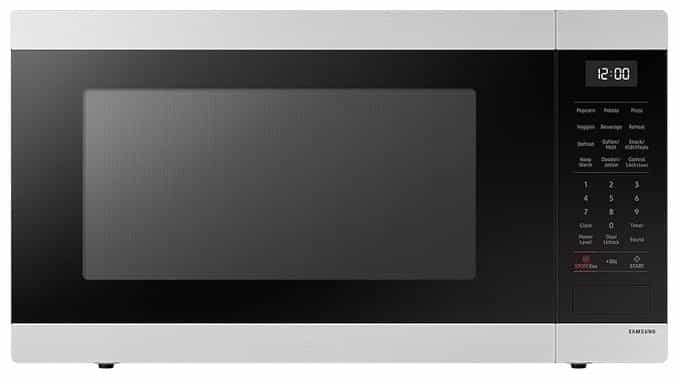
Samsung takes a fairly straightforward approach with this 1.9-cu.-ft. countertop microwave.
It has 950W cooking output, 10 power levels, Sensor Cook, Auto Defrost, cooking presets and Eco Mode. Samsung also uses an electronic-touch control panel rather than the membrane-touch description sometimes seen in retailer listings.
One of its more distinctive features is the ceramic-enamel interior. Samsung describes it as durable, scratch resistant and easier to maintain. The exterior also has a fingerprint-resistant finish.
The Samsung is also slightly shallower than the Panasonic and LG models in this comparison, at about 18 7/16 inches deep.
However, Samsung’s official specification sheet does not advertise inverter cooking technology for this model. Buyers specifically shopping for an inverter microwave therefore get a clearer match from Panasonic or LG.
There is also an availability wrinkle. Samsung’s U.S. page currently lists the model at $319, but direct delivery and in-store pickup were shown as unavailable when checked.
That may help explain why this particular Samsung countertop microwave can be harder to find at some major U.S. retailers than comparable Panasonic and LG models.
Panasonic NN-SN97JS
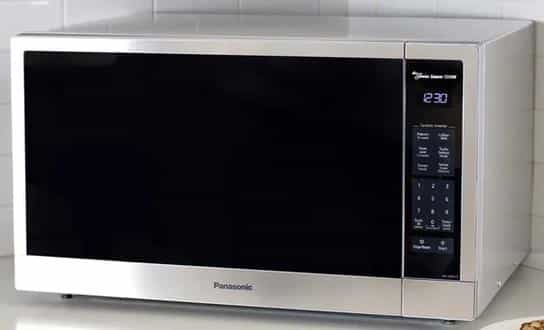
Panasonic takes the most technology-heavy approach of these three.
The NN-SN97JS has the largest capacity at 2.2 cu. ft. and the highest rated cooking output at 1250W. It uses Panasonic’s Cyclonic Wave Inverter system, which is designed to distribute microwave energy throughout the food rather than relying only on conventional full-power cycling.
Panasonic also includes a Genius Sensor, Sensor Reheat, Turbo Defrost, Quick 30 and 20 Auto Cook programs.
Its turntable measures 16.5 inches, making it the largest of the two models here for which the manufacturer publishes a turntable diameter.
At 23 7/8 inches wide, 14 inches high and 19 7/16 inches deep, it is also physically the largest of the three.
Panasonic supports optional 27-inch and 30-inch trim kits, so the microwave can also be incorporated into compatible cabinetry when installed according to Panasonic’s specifications.
Panasonic’s own U.S. store listed the NN-SN97JS at $439.95 when checked, so it sits at the expensive end of this comparison. Prices can of course change. (Shop Panasonic USA)
LG MSER2090S
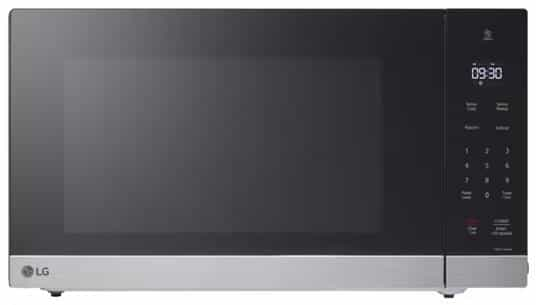
The LG MSER2090S is the current 2.0-cu.-ft. NeoChef countertop model and replaces the older LMC2075ST as the more relevant LG choice for this comparison.
It delivers 1200W microwave output and uses LG’s Smart Inverter technology. LG says the inverter is designed for more precise heating and defrosting.
The microwave has 10 power levels, seven Sensor Cook options and five Sensor Reheat options. It also includes a 16-inch turntable with LG’s hexagonal stabilizer ring.
For day-to-day cleaning and controls, LG gives the MSER2090S an EasyClean® interior and SmoothTouch® glass controls.
Its dimensions are 23 7/8 inches wide, 13 9/16 inches high and 19 3/8 inches deep, so its footprint is close to the Panasonic despite having slightly less capacity.
LG also offers a separate 30-inch trim kit for compatible installations.
When checked on LG’s U.S. site, the stainless-steel MSER2090S was listed at $259. Manufacturer prices and promotions can change, so current retailer pricing should always be checked before buying. (LG PL)
Inverter Microwave vs Samsung’s Power System
The biggest technology difference in this comparison is straightforward.
Both Panasonic and LG explicitly use inverter technology.
Panasonic calls its version Cyclonic Wave Inverter, while LG calls its system Smart Inverter.
Samsung lists 10 power levels and Sensor Cook for the MS19DG8500SRAA but does not identify the model as an inverter microwave in its current U.S. specifications.
If inverter technology is specifically on your shopping list, that immediately narrows this comparison to Panasonic and LG.
Which One Has the Most Space?
Panasonic wins the capacity comparison on paper:
Panasonic — 2.2 cu. ft.
LG — 2.0 cu. ft.
Samsung — 1.9 cu. ft.
The difference between 1.9 and 2.0 cu. ft. is relatively small, while Panasonic’s 2.2-cu.-ft. cavity provides a little more room for large plates, bowls and family-size dishes.
But countertop space matters too.
Samsung is the shallowest of the three, while Panasonic and LG extend a little over 19 inches deep. Anyone working with a limited-depth countertop should check the full installation and ventilation requirements before ordering.
Which Countertop Microwave Makes the Most Sense?
The answer depends more on what you value than on the brand name alone.
Samsung MS19DG8500SRAA makes sense if you specifically want Samsung’s ceramic-enamel interior, fingerprint-resistant exterior, slightly shallower cabinet or a Samsung appliance aesthetic. Just remember that its cooking output is 950W, not 1600W, and direct availability from Samsung was limited when checked.
Panasonic NN-SN97JS has the strongest specification sheet for shoppers prioritizing capacity and rated cooking output. It combines 2.2 cu. ft., 1250W and Cyclonic Wave Inverter technology, but it also carries the highest manufacturer price of the three.
LG MSER2090S lands between them in capacity at 2.0 cu. ft., while still delivering 1200W and Smart Inverter technology. Its current manufacturer price is also substantially below Panasonic’s, making it an especially interesting option when price and features both matter.
Samsung vs Panasonic vs LG
For sheer rated power and capacity, Panasonic NN-SN97JS has the strongest numbers.
For a combination of 1200W output, inverter technology, 2.0-cu.-ft. capacity and a lower current manufacturer price, the LG MSER2090S presents the strongest value proposition on the spec sheet.
The Samsung MS19DG8500SRAA remains different rather than directly superior or inferior: it offers Samsung’s ceramic-enamel interior, a slightly shallower cabinet and Sensor Cook, but has lower rated microwave output and currently appears less readily available directly from Samsung.
Whichever model you consider, compare the microwave cooking output, not simply the largest wattage number printed in a specification table. Input consumption and cooking output can describe two very different things.
Specifications and manufacturer pricing were verified against U.S. manufacturer sources on September 24, 2026. Prices, promotions and product availability can change.